What Is Hell?
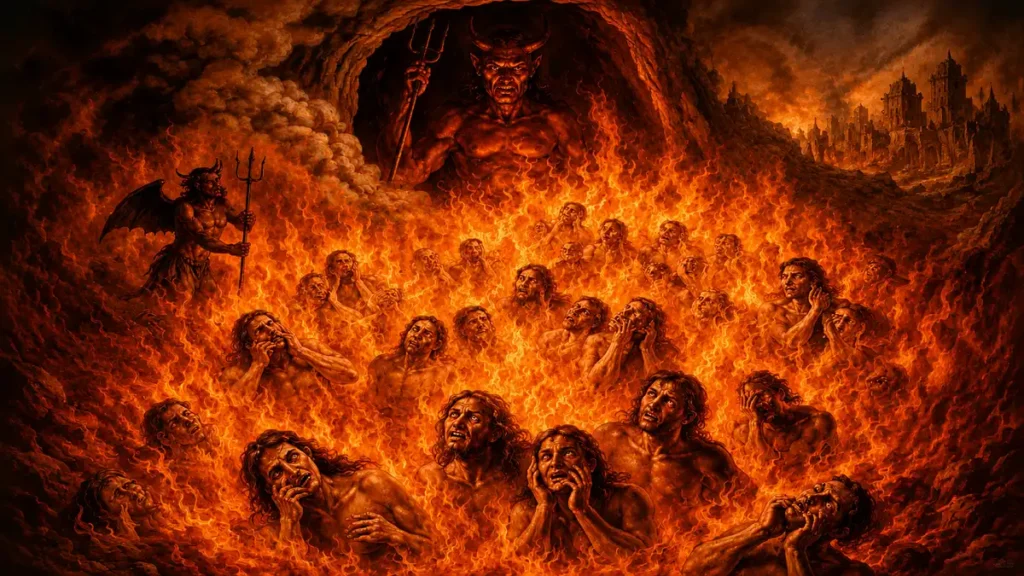
According to the Bible, hell is not a place where people are consciously tormented forever. The biblical words often translated as “hell” have different meanings and must be examined individually in their proper context.
For centuries, the Catholic Church and many Protestant churches have taught that hell is a literal place of blazing fire where the wicked are tormented forever. But does this teaching agree with the Bible’s description of the fate of the wicked? And where did the idea of eternal torment originate?
The question, then, is not what people throughout history have taught about hell, but what God’s Word teaches. Let us therefore examine the words and passages that form the basis for the idea of hell and see what they mean in their biblical context.
The English Word "Hell"
The word hell is an ancient English word that translators of the English Bible have often used to render the Hebrew word Sheol and the Greek words Hades, tartaroō, and Gehenna. In some English Bible translations, these same words have also been rendered as “grave” or “pit.”
In older English usage, the word hell carried the sense of hiding, concealing, or covering. It could therefore refer to a hidden or covered place. Over time, the word acquired a more specific religious meaning and came to be associated with a place of punishment after death.
Before this development, hell could appropriately be used as a translation of Sheol and Hades, because these words referred to the hidden and unseen condition of the dead.
The Word Gehenna Rendered as Hell
The Greek word Gehenna occurs twelve times in the Greek Scriptures: Matthew 5:22, 29, 30; 10:28; 18:9; 23:15, 33; Mark 9:43, 45, 47; Luke 12:5; and James 3:6. In many Bible translations, the word Gehenna is rendered as “hell.” Gehenna is the Greek form of the Hebrew Gehinnom, meaning “Valley of Hinnom.” This valley was located outside Jerusalem.
According to the traditional understanding, the valley was used as a place where the city’s refuse was burned. A continual fire was kept burning to consume what was thrown there, and sulfur was used to ensure complete destruction. The bodies of criminals considered unworthy of an honorable burial and the hope of a resurrection were also said to have been thrown there. It should be noted, however, that nothing living was thrown into Gehenna. The Jews were forbidden to torment any living creature.

When we consider that God, through the people of Israel, provided many lessons illustrating his ways and purposes—both present and future—we have good reason to consider whether the Valley of Hinnom, or Gehenna, was also an illustration of something to come.
In Scripture, Gehenna is a picture of “the second death”—the lake of fire. Unclean and detestable people who are unworthy of life and therefore are not permitted to live were represented by the refuse and unclean, lifeless bodies that were cast into Gehenna outside the city and consumed by the continually burning fire.
Therefore, the book of Revelation says:
“And if anyone was not found written in the Book of Life, he was cast into the Lake of Fire.” (Revelation 20:15, Interlinear Bible)
Here the fire represents destruction and annihilation. The imagery corresponds to Gehenna, or the Valley of Hinnom. The lake of fire is a symbol of final and everlasting destruction—eternal annihilation.
Revelation 20:14 says that both death and Hades are cast into the lake of fire. It is therefore evident that the lake of fire is symbolic, for death and Hades cannot literally be burned with fire; they can, however, be removed or destroyed. As Scripture says:
“Death shall be no more.” (Revelation 21:4)
And:
“The last enemy to be destroyed is death.” (1 Corinthians 15:26)
Gehenna was therefore a picture of the second death—final and complete destruction, from which there is no resurrection or restoration; for then “there no longer remains a sacrifice for sins,” but only “a fiery zeal that is about to consume the adversaries.” (Hebrews 10:26–27)
Guilty of the Fire of Gehenna
“You have heard that it was said to the ancients: “Do not commit murder!” And, whoever commits murder shall be liable to the judgment. But I say to you, everyone who is angry with his brother without a cause shall be liable to the judgment. And whoever says to his brother, Raca, shall be liable to the council; but whoever says, Fool! shall be liable to be thrown into the fire of Gehenna.” (Matthew 5:21–22, Interlinear Bible)
To understand Jesus’ words about “the judgment,” “the council,” and “the fire of Gehenna,” it is necessary to know something about the Jewish judicial system. “The judgment” referred to a lower court which, according to the historian Josephus, consisted of seven men and had authority to judge certain cases. “The council,” or the Sanhedrin, consisted of 71 men recognized for their learning and ability. This council constituted the Jewish supreme court and dealt with the most serious offenses.
The most severe sentence was death. But certain particularly detestable crimes brought disgrace upon the offender even after death, in that his body was not given a normal burial but was cast into Gehenna together with the carcasses of dogs and refuse to be destroyed.
This burning in Gehenna was intended to make both the crimes and the criminals abhorrent in the eyes of the people and signified that the one treated in this way was without hope. We should remember that Israel looked forward to a resurrection from the grave and therefore showed great care for the bodies of the dead. Since they did not have a full understanding of God’s almighty power, they apparently thought it necessary for the body to be preserved in order to be raised. Consequently, the destruction of the body in Gehenna meant to them the destruction of all hope of future life through a resurrection.
Gehenna therefore became a picture of the second death, just as the people of Israel in many respects served as an illustration of future conditions under God’s Kingdom.
Notice that in the words quoted above, Jesus pointed out to the Jews that although their application of the Law was strict, they had not grasped its full significance and deeper meaning. Jesus knew that the commandment, “You shall not murder,” was far more comprehensive than they imagined. Malicious anger and contempt would also be regarded as violations of God’s law under the new covenant.
Humans who, under the favorable conditions of the coming age, nevertheless refuse to change and conform to God’s righteous requirements will become liable to the second death, of which Gehenna was a picture. However, this law will be enforced in all its strictness against those who disregard the instruction, assistance, and privileges of that age.
The same thought is expressed in Matthew 5:29–30:
“But if your right eye offends you, take it out and throw it from you, for it is profitable to you that one of your members should perish and all your body not be thrown into Gehenna. And if your right hand causes you to offend, cut it off and throw it from you, for it is profitable to you that one of your members should perish and all your body not be thrown into Gehenna.” (Interlinear Bible)
Here again we see the difference between the operation of God’s law under the new covenant and its operation under the old covenant. Jesus urges self-control by emphasizing that it is far better to give up sinful desires than to lose the future life that God, through Christ, has made possible for humans to attain.
Gehenna is again presented as the second death—the final loss of life—not as a place of eternal torment.
God Can Destroy in Gehenna
“And you should not fear the ones killing the body, but not being able to kill the soul. But rather fear him being able to destroy both soul and body in Gehenna.” (Matthew 10:28, Interlinear Bible)
Here Jesus tells his followers why they could be bold and courageous even under the severest trials. They were to expect persecution and opposition because of him and the good news they had been sent out to proclaim. Indeed, the time would come when people would kill them and think that by doing so they were rendering service to God.
Their hope and reward therefore did not lie in this life, but in the life to come. Jesus had given his life as a ransom for all, and therefore all who are in the graves will, at the appointed time, hear his voice and come forth. Humans can take our present life from us, but they cannot deprive us of the future life that God has promised.
That is why Jesus says: Do not fear those who can only kill the body. Rather, fear God, who alone has authority over both the present life and the future life.
Notice Jesus’ words. He does not say that God will preserve people in eternal torment in Gehenna. He says that God can destroy both soul and body in Gehenna. Gehenna is therefore presented as the second death—the complete destruction of life and all hope of a future existence.
Here it is clearly shown that Gehenna, when understood as a picture, represents the second death. Scripture does not say that God will preserve soul and body for eternal torment, but that he can destroy them both in Gehenna. Anyone sentenced to the second death is destroyed forever, without hope of resurrection or restoration.
The Eternal Fire—The Gehenna of Fire
“And if your hand or your foot causes you to stumble, cut it off and cast it from you. It is better for you to enter into life lame or crippled than, having two hands or two feet, to be cast into the eternal fire. And if your eye causes you to stumble, tear it out and cast it from you. It is better for you to enter into life with one eye than, having two eyes, to be cast into the Gehenna of fire.” (Matthew 18:8–9, Interlinear Bible)
After reading this passage, we must agree with the prophet that Jesus spoke in “figurative speech” and “parables” (Psalm 78:2; see also Matthew 13:34–35). No one imagines for a moment that Jesus was literally telling people to cut off their limbs or tear out their eyes.
The Jews to whom Jesus spoke were not familiar with the idea of a place of eternal torment. They knew that Gehenna was the name of the valley outside Jerusalem and that this valley was neither a place of torment nor a place into which living creatures were thrown. Everything thrown into it was burned up and completely destroyed.
They therefore understood that Jesus’ words about eyes and limbs were figurative, and that Gehenna was likewise used as a picture of complete destruction and annihilation.
What Jesus meant was simply this: The future life that God has prepared for redeemed mankind is of such immeasurable value that any sacrifice made to attain it would be well worth it. Jesus’ listeners no doubt understood that it was better to deny themselves many of this world’s pleasures and desires than to lose the opportunity to attain eternal life. The alternative was not eternal torment; rather, it could be destruction in Gehenna—the second death, which is also called the lake of fire (Revelation 21:8).
Maggots That Do Not Die
“And if your hand causes you to stumble, cut it off. It is better for you to enter into life crippled than, having two hands, to go away into Gehenna, into the unquenchable fire, where their maggot does not die, and the fire is not quenched. And if your foot causes you to stumble, cut it off. It is better for you to enter into life lame than, having two feet, to be cast into Gehenna, where their maggot does not die, and the fire is not quenched. And if your eye causes you to stumble, cast it away. It is better for you to enter into the Kingdom of God with one eye than, having two eyes, to be cast into the Gehenna of fire.” (Mark 9:43–47, Interlinear Bible)
But what did Jesus mean by “maggots” that do not die and a fire that is not quenched?
In the literal Gehenna that forms the background of Jesus’ illustration, the bodies of dead humans and animals would sometimes fall onto rocky ledges rather than directly into the fire. If such a body landed on a slope or ledge, it would be consumed by maggots breeding there just as surely and completely as the fire consumed the bodies that fell to the bottom of the valley.
Nothing that had been cast into this valley was permitted to be touched. The maggots and the fire could therefore complete their work of destruction.
The fire was not quenched, and the maggots did not die out. This does not mean that the fire would burn forever or that the maggots were immortal. The point is that the maggots did not die out before their work was complete, and the fire was not quenched before everything was consumed.
If a house caught fire and the fire could not be stopped or extinguished but continued until the entire house had burned down, it could rightly be called an “unquenchable fire.” Not because it burned forever, but because it was not extinguished before its work was complete.
Jesus wanted to emphasize how complete and irreversible the second death is. All who die the second death are completely and eternally destroyed.
It is not only in Mark 9:43–47 that the second death is portrayed through the imagery of Gehenna. Jesus uses the same basic imagery in the symbolism of Revelation, where Gehenna corresponds to what is called the lake of fire.
Gehenna in Isaiah
“And they shall go out and see the dead bodies of the men who rebelled against me; for their maggot shall not die, and their fire shall not be quenched; and they shall be an abhorrence to all flesh.” (Isaiah 66:24, Interlinear Bible)
Jesus’ words about Gehenna have a clear connection with the prophet Isaiah. When Jesus speaks of the maggot that does not die and the fire that is not quenched, he uses the words of Isaiah 66:24. Although Isaiah does not mention the Valley of Hinnom by name, Jesus’ use of these words shows that the prophet’s description forms the background for his reference to Gehenna.
These people are portrayed as completely and finally destroyed. The imagery is therefore the same as in Jesus’ references to Gehenna: not eternal torment, but the final destruction of those who deliberately reject God and his righteousness.
Notice also that the two preceding verses (Isaiah 66:22–23) show when this prophecy will be fulfilled. It takes place under the coming world order, described as “new heavens and a new earth.” This corresponds with the symbolism found in Revelation.
At that time, all righteous people will come to understand how just and wise it is to remove all incorrigible and willful enemies of righteousness. As it is written:
“They shall be an abhorrence to all flesh.”
How Will You Escape the Judgment of Gehenna?
“Woe to you, scribes and Pharisees, hypocrites! For you travel over sea and land to make one proselyte, and when he becomes one, you make him a son of Gehenna twice as much as yourselves… Serpents! Offspring of vipers! How will you escape the judgment of Gehenna?” (Matthew 23:15, 33, Interlinear Bible)
Jesus did not address these words to Gentiles who had no knowledge of the truth, nor to the most ignorant among the Jews. He directed them to the scribes and Pharisees, who outwardly appeared to be the most religious and served as the leaders and teachers of the people.
These men were hypocritical. They were not sincere in following what they themselves knew to be true. Abundant evidence had been given to them, but they refused to accept it. On the contrary, they sought to oppose the truth and prevent the people from accepting it.
By thus resisting the holy spirit of light and truth, they hardened their hearts against the work God desired to accomplish among them. They resisted his grace, and such a course, if continued, can ultimately lead to condemnation to the second death—Gehenna.
Every step toward willful blindness and resistance to the truth makes it more difficult to turn back. It gradually shapes a person’s character in a direction that God cannot approve and that the second death is intended to remove.
The scribes and Pharisees were rapidly moving in this direction, and that is why Jesus confronted them with the solemn question:
“How will you escape the judgment of Gehenna?”
Set on Fire by Gehenna
“And the tongue is a fire, the world of iniquity. So the tongue is set among our members, spotting all the body, and inflaming the course of nature, and having been inflamed by Gehenna.” (James 3:6, Interlinear Bible)
In strong, symbolic language, the apostle here speaks of the great and corrupting influence that an evil tongue can have—a tongue that is figuratively set on fire by the figurative Gehenna.
A human tongue obviously cannot literally be in Gehenna and be set on fire from there. James’ words therefore clearly show that Gehenna is used figuratively here as a representation of a destructive influence.
For a tongue to be set on fire by Gehenna means that it is driven by an evil and distorted disposition—willful, selfish, hateful, and malicious. These are the kinds of character traits that, if allowed to develop unchecked despite knowledge and opportunity for repentance, can lead to the judgment of which Gehenna is a picture.
A person with such a disposition can use the tongue to kindle a dangerous fire and create a corrupting turmoil that, wherever it finds something to act upon, produces harmful effects and damages the entire “wheel of life.”
A few malicious words often stir up evil passions in the speaker, arouse a similar disposition in others who hear them, and then have a harmful effect on the one who first spoke them. Continuing on this course can eventually corrupt the whole person and lead to the judgment that he is unworthy of life.
The Rich Man and Lazarus
In Luke 16:19–31, Jesus tells a parable about the rich man and Lazarus. The great difficulty for many who read this parable is that although they regard it as a parable, they nevertheless conclude that it should be understood literally.
It is worth noting that Jesus does not use the word Gehenna in this parable. In the Greek text, the word is Hades, the Greek term corresponding to the Hebrew Sheol and referring to the realm of the dead.
If the parable were to be understood literally, it would lead to several unreasonable conclusions. The rich man went to the realm of the dead (Hades) and suffered torment, apparently because he had enjoyed many earthly advantages and had given Lazarus no more than crumbs from his table.
Not a single word is said about the rich man being wicked. Nor is a single word said about Lazarus being a sincere child of God, full of faith in God, or about him being a good man. On the contrary, he was blessed and comforted, apparently because he was poor and sick.
If this is to be interpreted literally, the logical conclusion would be that unless we are poor beggars covered with sores, we can never attain blessedness after this life. And if we are well dressed and have more than enough to eat every day, then torment awaits us in the realm of the dead.
Furthermore, the desirable place where one enjoys God’s favor is described as “Abraham’s bosom.” If the entire account is to be understood literally, then this bosom must also be literal, and it could hardly hold the millions of poor and sick people of the earth.
Consider also the following: Is it reasonable or biblical to believe that a person must suffer torment simply because he is rich, well dressed, and has plenty to eat? Is it biblical to believe that a person attains eternal life simply because he is poor? Is the realm of the dead literally so close to God’s Kingdom that a person in one place can speak with a person in the other? And if the rich man were literally in a blazing fire, how could Abraham send Lazarus to him with a single drop of water on the tip of his finger to cool his tongue?
But why dwell on these unreasonable conclusions? In a parable, one naturally does not state directly what one intends to teach. We know this from the explanations Jesus himself gave of his parables. When he spoke of “wheat,” he did not mean literal wheat, but “the sons of the Kingdom.” When he spoke of “the weeds,” he meant “the sons of the wicked one,” and by “the reapers” he meant “angels” (Matthew 13).
What, then, did Jesus intend to illustrate by the parable of the rich man and Lazarus? Since Jesus himself gives no interpretation of this parable, we must approach it with caution. I will therefore humbly present the understanding that, in my view, best agrees with the rest of Scripture.
As I understand it, the rich man symbolizes the Jewish nation and its religious leaders, who rejected Jesus and later had him put to death. Lazarus pictures the common people and the Gentiles who accepted God’s Son.
The Bible shows that death is sometimes used as a symbol of a great change in a person’s life or standing (see Romans 6:2, 11–13; 7:4–6).
Such a change took place when Jesus gave spiritual food to the Lazarus class and when this group came into the favor of the greater Abraham, God. At the same time, the Jewish nation and its religious leaders “died” with respect to their favored standing in relation to God’s Kingdom. They were rejected when Jesus told the chief priests and the elders of the people that the Kingdom of God would be taken away from them (Matthew 21:43), and they were tormented when Christ’s disciples exposed their evil deeds (Acts 7:51–57).
In my view, therefore, this parable does not teach that people are tormented in literal fire in the realm of the dead after death. When it is considered alongside the rest of Scripture’s testimony concerning Sheol and Hades, it seems far more natural to understand it figuratively rather than literally.
Eternal Punishment, but Not Eternal Torment
In Matthew 25:31–46, we read the parable of the sheep and the goats. Concerning these, it says:
“And these (the goats) shall go away into eternal punishment, but the righteous into eternal life.” (Interlinear Bible)
While Scripture, as I understand it, does not teach eternal torment, it does clearly teach eternal punishment for the wicked. Since it is therefore established that Scripture says the punishment is without end, only one question remains to be considered: What is the nature of that punishment?
What does the Bible say about the punishment of people who despise and reject all of God’s provisions of grace? Does God really say anywhere that sinners will live and be tormented forever?
I cannot find a single passage in the Bible where life in any form is promised to those who perish. And while I cannot find a single verse anywhere in the Bible that speaks of sinners existing eternally in literal torment or in any other conscious state, I find many passages that say the opposite. Here are a few examples from the Interlinear Bible:
“For the wages of sin is death.” (Romans 6:23)
“The soul that sins, it shall die.” (Ezekiel 18:4)
“He destroys all the wicked.” (Psalm 145:20)
“But the wicked shall perish.” (Psalm 37:20)
“For those who do evil shall be cut off.” (Psalm 37:9)
“But the transgressors shall be destroyed together.” (Psalm 37:38)
“But the wicked shall be cut off from the earth, and the transgressors shall be rooted out of it.” (Proverbs 2:22)
“And he shall slay the wicked with the breath of his lips.” (Isaiah 11:4)
From these and many other passages, we see how the Bible describes the punishment of the wicked. They are not portrayed as living in eternal torment, but as people who perish, are destroyed, cut off, and brought to an end.
The punishment is eternal because its effect is final and irreversible.
The Lake That Burns with Fire and Sulfur
The “lake of fire that burns with sulfur” is mentioned several times in the book of Revelation. This book is recognized by all Christians as being highly symbolic. Yet many regard this particular symbol—the lake of fire—as a literal depiction that supposedly supports the doctrine of eternal torment. But the symbol is explicitly explained in the text itself:
“And death and Hades were cast into the lake of fire. This is the second death.” (Revelation 20:14, Interlinear Bible)
At times it is called “the lake of fire that burns with sulfur” (Revelation 19:20). Sulfur appears in several places in the Bible as part of imagery of destructive judgment and therefore reinforces the lake of fire as a picture of destruction.
That the lake of fire is symbolic can be clearly seen from the fact that both death and Hades (the realm of the dead) are cast into it (Revelation 20:14). Neither death nor Hades is a physical object that can be burned up in literal fire. The imagery therefore represents their final end or destruction.
This destruction is called “the second death,” in contrast to the first death, which all mankind has inherited from Adam. A resurrection from the first death has been assured. According to Jesus’ words, all who are in the graves will hear his voice and come forth (John 5:28), and Revelation says:
“And the sea gave up the dead who were in it, and death and Hades gave up the dead who were in them.” (Revelation 20:13, Interlinear Bible)
The first death, which has afflicted mankind since Adam’s sin, will therefore come to an end forever. It will itself be destroyed in the second death when Jesus Christ completes his work of redemption. That is why God says through the prophet Hosea:
“I will ransom them from the hand of Sheol; I will redeem them from death. Death, where are your plagues? Sheol, where is your destruction?” (Hosea 13:14, Interlinear Bible)
The first death will no longer have power over humans as it has since Adam’s sin. When God’s Kingdom rules over the earth, people will no longer die because of Adam’s sin but will be held accountable for their own actions. As Jeremiah writes:
“In those days they shall no longer say: ‘The fathers have eaten sour grapes, and the sons’ teeth have become dull.’ But everyone shall die for his own wrongdoing; every man who eats the sour grapes, his teeth shall become dull.” (Jeremiah 31:29–30, Interlinear Bible)
Concluding Comment
We have now examined the Bible’s use of the word Gehenna (hell) and the principal passages that are often associated with the doctrine of eternal torment. We have seen that Gehenna was the Valley of Hinnom outside Jerusalem, where refuse and dead bodies were destroyed. Jesus used this valley as a picture of the second death—the final punishment of those who deliberately reject God and righteousness.
We have also seen that the Bible consistently describes the fate of the wicked with words such as death, destruction, annihilation, and being cut off. Nowhere did we find a clear biblical statement that people will continue to live in conscious torment for all eternity. On the contrary, Scripture itself explains that the lake of fire is “the second death” (Revelation 20:14) and that Gehenna is a picture of final and irreversible punishment. The punishment is eternal, not because people are tormented without end, but because its effect is final, with no possibility of restoration.
Everyone must, of course, examine these things for themselves and determine what Scripture teaches. But as I understand it, the overall testimony of the Bible shows that hell is not a place of eternal torment. It is a picture of the second death—the final destruction of sin and rebellion against God.
Related Articles
Explore More
© 2026 Skriften.dk