What Is Religion According to the Bible?

Religion is the way people practice faith and worship. It is expressed through doctrines, rituals, traditions, communities, and religious institutions. Religion is therefore often described as a religious system.
Regardless of how religion is defined, most people would agree that it has had an enormous influence on human life. Throughout history, religion has shaped cultures, societies, and world events, and it remains one of the most powerful forces in the world. For many people, religion is not merely a belief, but the foundation of their values, hopes, and way of life.
But the question is whether religion has truly led people to the truth. That question may seem surprising. Many take it for granted that any sincere religion brings people closer to God. The Bible, however, presents a different picture.
An Encounter I Never Forgot
When I was young, I traveled around the world. One day, I was sitting on a subway when I noticed a man reading his Bible. He seemed unusually happy, and suddenly he said to the passengers around him:
“The Bible is not a religion—it is the truth.”
We asked him what religion or denomination he belonged to. To my surprise, he replied:
“None.”
I clearly remember several people shaking their heads. Some thought he had misunderstood everything, while others thought he sounded strange.
I did not understand what he meant either. To me, the Bible was inseparably connected with religion. How could anyone claim that the Bible was not a religion when it formed the basis of some of the world’s largest religions?
I did not think much more about his words that day, but they kept coming back to me. What did he really mean? Could there actually be a difference between the Bible and religion? Or had he simply misunderstood everything?

I never forgot that encounter. It was not until many years later, after I had studied the Bible and religion for myself, that I began to understand what he meant. I discovered that the Bible does not call people to a religion, but to the truth.
That became the beginning of an entirely new way of studying the Bible. Instead of asking which religion seemed most convincing, I began to ask: What does Scripture actually teach?
Over time, I discovered that religions are built on human traditions, creeds, and philosophical ideas rather than on the teachings of Scripture. At the same time, it became clear to me that the Bible describes a spiritual conflict in which unseen powers seek to lead people away from the truth and toward a form of worship that God has not approved. This completely changed my view of religion and marked the beginning of a long investigation into what the Bible actually teaches.
What Authority Should Determine the Truth?
If we are to determine what true religion is, we must first address an even more fundamental question:
What authority should determine what is true and what is false?
Should it be the religions’ own sacred writings, creeds, and traditions? Or should it be the Bible?
If we agree that the Bible is God’s Word and therefore the highest authority, we have a common basis for examining religion. We can then test every religious teaching and every religious tradition by the same standard.
If, on the other hand, we do not agree on the authority, we will inevitably reach different conclusions. Therefore, the question of authority must be settled before we can examine what true religion is.
Many people compare religions on the basis of their history, ethics, influence, or number of followers. But none of these things can determine whether a religion is true. A religion is not necessarily true simply because it is old, popular, or has millions of followers. If truth is to be determined, it must be tested against an authority that stands above all religions.
The biblical test does not require a theological education. Nor is it necessary to know the detailed teachings of every religion or to become familiar with all its traditions. The Bible provides some simple and fundamental truths against which any religion can be tested.
Therefore, people of all educational backgrounds can examine for themselves whether a religion is based on the teachings of Scripture or on human traditions.
If a religion agrees with the teachings of Scripture, it passes the test. If it is based on human traditions or teaches something that contradicts Scripture, it does not pass the test.
In what follows, we will examine what these fundamental truths are and how they can be used to test any religion.
Who Holds the Power in the World?
If religion is to be tested by using the Bible as the standard, we must first understand the world in which religions have arisen. The Bible describes the world in a very different way from what most people imagine.
One of the first questions, therefore, is:
Who holds the power in the world?
You may remember that after Jesus was baptized by John, he spent forty days in the wilderness. At the end of that time, Satan came to tempt him. What Satan said on this occasion gives us valuable insight into who has power over the world:
“And the Devil led him up onto a high mountain and showed him all the kingdoms of the world in a moment of time. And the Devil said to him: ‘I will give you all this authority and their glory, for it has been delivered to me, and I give it to whomever I wish. Therefore, if you will worship before me, it will all be yours.’” (Luke 4:5–7, Interlinear Bible)
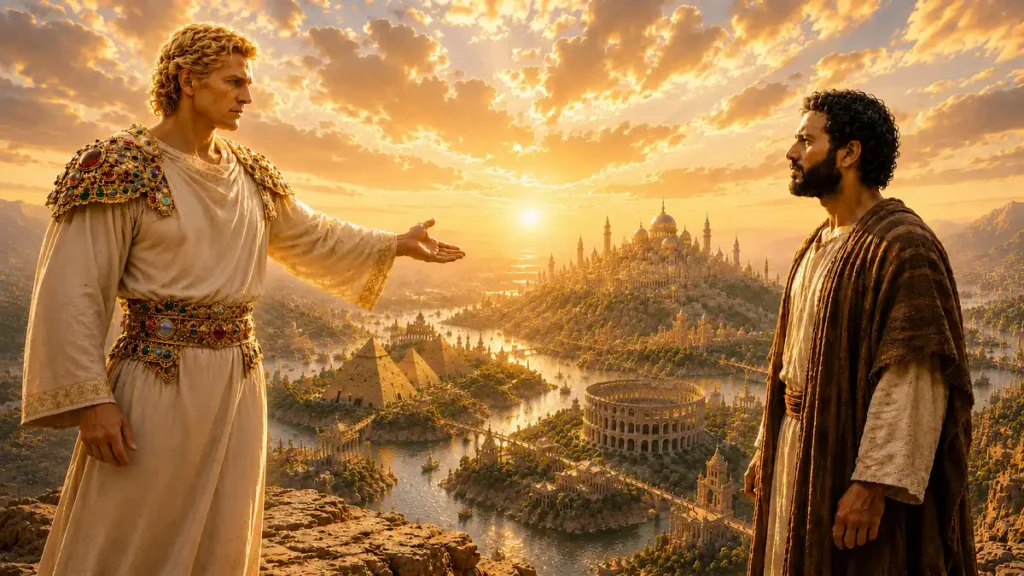
It is worth noting that Jesus did not contradict Satan’s words. Satan said that the kingdoms of the world had been delivered to him, and Jesus did not deny this claim. Instead, he rejected the temptation and affirmed that worship belongs to God alone. He simply answered:
“Get behind me, Satan! For it has been written: You shall worship the Lord your God, and him only you shall serve.” (Luke 4:8, Interlinear Bible)
If the kingdoms of the world have been delivered to Satan, this must include not only the political realm but also the religious realm. Religion belongs to this world, and therefore we must examine what the Bible says about the origin of religion.
You may think that the situation became entirely different after Jesus’ death and resurrection—that Jesus had now taken over the rule of the world. But many years later, the apostle John writes:
“We know that we are of God, and the whole world lies in the evil one.” (1 John 5:19, Interlinear Bible)
The world therefore remains under the power of the Evil One. This condition will not end until Jesus Christ returns to establish God’s Kingdom. This naturally raises another question: Where does religion come from?
Where Does Religion Come From?
If Satan has been given authority over this world, a natural question arises:
What does the Bible say about the origin of religions?
The Bible gives a clear answer. In several places, it teaches that worship that is not directed to the true God is actually connected with demonic powers.
Moses writes:
“They sacrificed to demons who were not God, to gods whom they did not know, new ones who came lately. Your fathers had not feared them.” (Deuteronomy 32:17, Interlinear Bible)
The apostle Paul confirms the same truth:
“But the things the nations sacrifice, they sacrifice to demons, and not to God. I do not want you to have fellowship with demons. You cannot drink the cup of the Lord and the cup of demons; you cannot partake of the table of the Lord and the table of demons.” (1 Corinthians 10:20–22, Interlinear Bible)
These scriptures clearly show that the Bible does not regard the worship of other gods as innocent religious traditions. It teaches that such worship is actually connected with demonic powers.
Jesus also refers to Satan as the chief of the demons:
“But some of them said, he casts out the demons by Beelzebub the chief of the demons. And tempting him, others were seeking a sign from heaven from him. But knowing their thoughts, he said to them, Every kingdom divided against itself is brought to ruin, and a house against a house falls. And also, if Satan is divided against himself, how shall his kingdom stand? Because you say I cast out the demons by Beelzebub.” (Luke 11:15–18, Interlinear Bible)

Jesus does not merely refer to Satan as the chief of the demons. He also speaks of “Satan’s kingdom.” This agrees with Satan’s own words during the temptation in the wilderness, when he said that the kingdoms of the world had been delivered to him. Jesus never contradicted this claim. On the contrary, he later speaks of Satan as ruling over a kingdom. Together, these scriptures present a picture of a world under Satan’s dominion and of a kingdom over which he rules.
Paul also calls Satan “the god of this world” (2 Corinthians 4:4). When the Bible at the same time teaches that worship not directed to the true God is actually directed to demons, a very different picture of religion emerges from what most people imagine. Scripture also says:
“For all the gods of the peoples are idols…” (Psalm 96:5, Interlinear Bible)
Religion, therefore, is not merely mankind’s attempt to seek God. The Bible shows that behind the religions of the world there are also spiritual powers seeking to lead people away from the truth and from the true worship of God. They do this through religion, human traditions, and false teachings.
Religion or Truth?
Jesus said the following about some of the religious leaders of his day:
“Leave them alone. They are blind leaders of the blind; and if the blind lead the blind, both will fall into a pit.” (Matthew 15:14, Interlinear Bible)
Those were strong words. Jesus directed his criticism at the religious leaders because they had made the word of God invalid through their traditions and were thereby leading people away from the truth.
The Bible teaches that there is both truth and falsehood. God does not approve of every form of worship, but only worship that is based on the truth. Jesus said:
“But an hour is coming, and now is, when the true worshipers will worship the Father in spirit and in truth. For the Father also seeks such ones that worship him. God is spirit, and the ones worshiping him must worship in spirit and truth.” (John 4:23–24, Interlinear Bible)
This means that true worship is not determined by which religion a person belongs to, but by whether it agrees with God’s Word. Therefore, the primary question is not which religion a person belongs to, but whether its teachings agree with Scripture.
If a religion’s teachings contradict Scripture, it cannot be true, regardless of how old, widespread, or respected it may be.
The First Biblical Test
If a religion is to be tested by using Scripture as the standard, we must begin with the most fundamental questions.
The Bible gives a clear answer to these two questions, which every religion must be able to answer correctly if it is true:
- Who is God Most High, and is he one or more than one?
- Who is God’s Anointed One?
This is the first biblical test. If a religion cannot give the biblical answer to these two questions, it has already shown that it is not based on the teachings of Scripture, and further examination is unnecessary.
If, on the other hand, a religion passes this first test, that does not necessarily mean that it is true. It must be tested further. Its other teachings must also be examined to determine whether they agree with Scripture.
Who Is God Most High?
“I have lifted up my hand to Yahweh, the most high God, the possessor of Heaven and earth.” (Genesis 14:22, Interlinear Bible)
“But Yahweh is the true God, He is the living God and the everlasting King.” (Jeremiah 10:10, Interlinear Bible)
“Hear, O Israel, Yahweh our God, Yahweh is one. And you shall love Yahweh your God with all your heart, and with all your soul, and with all your might.” (Deuteronomy 6:4–5, Interlinear Bible)
The Bible teaches that Yahweh is the only true God. He is God Most High, and He is one.
Any religion that teaches something different about God therefore fails this first biblical test.
Who Is God's Anointed One?
“And Simon Peter answered and said: You are the Christ, the Son of the living God.” (Matthew 16:16, Interlinear Bible)
“Which He promised beforehand through His prophets in the Holy Scriptures, concerning His Son, who according to the flesh came from the seed of David, who was declared to be the Son of God in power according to the Spirit of holiness by the resurrection from the dead, Jesus Christ our Lord.” (Romans 1:2–4, Interlinear Bible)
“But these things have been written so that you may believe that Jesus is the Christ, the Son of God…” (John 20:31, Interlinear Bible)
The Bible teaches that Jesus of Nazareth is God’s Anointed One and God’s Son. He is the Christ whom God promised through the prophets.
Any religion that rejects this truth therefore also fails the first biblical test.
If a religion fails to answer these two fundamental questions in accordance with Scripture, there is no need to examine its other teachings. If, on the other hand, it passes this first biblical test, it must be examined more closely to determine whether its other teachings also agree with Scripture or whether it is based on human traditions and unbiblical teachings.
There are religions that give the biblical answer to these two questions. But when they are examined more closely, it often becomes apparent that they are nevertheless based on human traditions and unbiblical teachings that lead people away from the truth.
Satan does not care what the label on the bottle says—as long as he can mix a lie with the truth. Even a small amount of falsehood is enough to lead people away from the truth. Whether the bottle is labeled Christianity, Islam, Hinduism, or something else entirely makes no difference if its contents do not agree with Scripture.
Test Religion by Scripture
The first biblical test can now be applied to the religions of the world.
The purpose is not to judge people, but to test the teachings of religions by using Scripture as the standard. What matters is not how many followers a religion has, how old it is, or how sincere its followers are. The only question is whether its teachings agree with the Bible.
Let us test some of the world’s religions.
Islam
Islam teaches that God is one, which agrees with Scripture. But Islam rejects that Jesus is the Son of God and the promised Christ. Therefore, Islam does not pass the first biblical test.
Hinduism and Buddhism
Neither Hinduism nor Buddhism teaches that Yahweh is the only true God or that Jesus is God’s Anointed One. Therefore, both fail the first biblical test.
Judaism
Judaism teaches that Yahweh is the only true God and that he is one. On this point, it agrees with Scripture.
But it rejects that Jesus of Nazareth is God’s Anointed One and the promised Messiah. Therefore, Judaism does not pass the first biblical test.
The first biblical test thus shows that none of these religions fully agrees with Scripture. Since they all fail the first biblical test, further examination is unnecessary.
To some, this test may seem far too simple. Can a religion with millions or billions of followers really be evaluated by asking just two questions?
The answer is yes—if the questions concern the religion’s most fundamental teachings. If a religion cannot give the biblical answer as to who God Most High is, whether he is one or more than one, and who God’s Anointed One is, it has already shown that it is not based on the teachings of Scripture. There is therefore no reason to examine all its other teachings.
If, on the other hand, a religion passes this first test, that does not mean that it is true. It simply means that it warrants further examination, in which its other teachings must also be tested by Scripture.
It is similar to a medical examination. If the initial tests show that a patient does not meet the basic requirements for a particular treatment, there is no reason to proceed with the remaining examinations. If, on the other hand, the patient passes the initial tests, further examinations follow. The first biblical test works in the same way. It does not rule out examining a religion more closely—it simply determines whether there is any basis for proceeding further.
What About Christianity?
But what about Christianity—is it the true religion?
Christianity, with the Catholic Church as its mother church and the many church systems that have emerged from her throughout history, encompasses more than two billion people. It has shaped world history for nearly two thousand years, and its teachings have had an enormous influence on cultures, societies, and politics.
But the question is not how large or influential Christianity is.
The question is whether the church systems of Christianity truly represent the God of Scripture and His Anointed One, Jesus Christ. Do they follow the Bible as the sole authority for their faith and teachings? Or has Christianity also added human traditions and unbiblical teachings?
Unfortunately, Christianity cannot pass the biblical test either. Several of its creeds and doctrines directly contradict Scripture. This subject is examined in greater detail in other articles on Skriften.dk, but here I will mention only some of the main points where Christianity differs from the teachings of the Bible:
- Christianity’s doctrine of a triune God does not agree with Scripture’s teaching about Yahweh as the one true God.
- Christianity teaches that Jesus of Nazareth was fully God and fully man—that Jesus is Yahweh. Scripture, on the other hand, teaches that he is the Son of God and the Anointed One.
- The word “Christianity” is not found in Scripture.
- Christianity has also adopted numerous religious practices and traditions that are not prescribed in Scripture, including the use of temples (church buildings), crosses, incense, holy water, infant baptism, Christmas celebrations, processions, paid clergy, clerical robes, liturgical vestments, and the veneration of saints.
Many of Christianity’s teachings do not agree with Scripture, and if Scripture is the standard for true religion, Christianity therefore cannot be the true religion.
The fact that Christianity does not profess the God of Scripture—the one God of Israel, Yahweh—but instead worships a different god from the one proclaimed by Jesus and the apostles should cause anyone seeking the truth to stop and examine whether the religion’s teachings truly agree with the Bible.
But if Christianity is not the true religion either—then which religion is the true one?
Truth Rather Than Religion
Throughout this article, we have examined religion by using Scripture as the standard. But the Bible actually points to something other than religion. It does not call people to a religion, but to the truth.
It is remarkable that the Bible speaks again and again about the truth. It encourages people to know the truth, live in the truth, and walk in the truth. But it never encourages people to live in a religion.
The Greek word aletheia (truth) occurs many times in the Greek Scriptures. When we examine these passages, we see that the Bible repeatedly points to the truth as the way to God.
Let us look at some of the places where the word aletheia (truth) occurs in Scripture:
“For this I have been born, and for this I have come into the world, that I should testify to the truth. Everyone who is of the truth hears my voice.” (John 18:37, Interlinear Bible)
“Jesus said to him: I am the way and the truth and the life. No one comes to the Father except through me.” (John 14:6, Interlinear Bible)
“Sanctify them in the truth; your word is truth.” (John 17:17, Interlinear Bible)
“For I rejoiced greatly when the brothers came and testified to your truth, how you walk in the truth.” (3 John 1:3, Interlinear Bible)
“For the wrath of God is revealed from heaven against all ungodliness and unrighteousness of men who suppress the truth in unrighteousness.” (Romans 1:18, Interlinear Bible)
“But to those who are self-seeking and disobedient to the truth, but obey unrighteousness, there will be wrath and indignation.” (Romans 2:8, Interlinear Bible)
“For there will be a time when they will not endure sound teaching, but according to their own desires they will heap up teachers for themselves, having itching ears. And they will turn their ears away from the truth and turn aside to myths.” (2 Timothy 4:3–4, Interlinear Bible)
“This testimony is true. Therefore rebuke them sharply, so that they may be sound in the faith, not paying attention to Jewish myths and commandments of men who have turned away from the truth.” (Titus 1:13–14, Interlinear Bible)
What do these scriptures show?
They show that Jesus came to testify to the truth and that he himself is the truth that leads people to the Father. God’s Word is truth, and his children are to walk in the truth. At the same time, the Bible warns that the truth is suppressed, that many turn away from it, and that people instead follow myths and human commandments.
Scripture therefore does not describe the decisive conflict as a conflict between the world’s religions. It describes it as a conflict between truth and falsehood. The world’s religions continue to grow and shape the lives of billions of people. But the Bible does not direct attention to the size or influence of religions. It directs attention to the truth.
The decisive question, therefore, is not which religion a person belongs to, but whether that person follows the truth that God has revealed in his Word.
When the Way of Truth Was Brought into Disrepute
Followers of Christianity may say:
“Christianity is the true religion because the truth is the same as Christianity.”
But Scripture says otherwise.
Jesus did not come into the world to testify to Christianity. He came to testify to the truth:
“For this I have been born, and for this I have come into the world, that I should testify to the truth. Everyone who is of the truth hears my voice.” (John 18:37, Interlinear Bible)
It is also worth noting that the word “Christianity” does not appear in Scripture. The Bible does not call people to Christianity, but to the truth.
At the same time, Jesus and the apostles warned that this truth would not remain untouched. On the contrary, they foretold that false teachers would enter among the believers and lead many away from the truth.
Peter and Paul write:
“But there were also false prophets among the people, as there will also be false teachers among you. They will secretly bring in destructive heresies, even denying the Master who bought them, bringing swift destruction upon themselves. And many will follow their licentious ways, and because of them the way of truth will be brought into disrepute.” (2 Peter 2:1–2, Interlinear Bible)
“But the Spirit expressly says that in later times some will depart from the faith, giving heed to deceiving spirits and teachings of demons.” (1 Timothy 4:1, Interlinear Bible)
“For there will be a time when they will not endure sound teaching, but according to their own desires they will heap up teachers for themselves, having itching ears. And they will turn their ears away from the truth and turn aside to myths.” (2 Timothy 4:3–4, Interlinear Bible)
Peter says of these false teachers:
“… and because of them the way of truth will be brought into disrepute.” (2 Peter 2:2, Interlinear Bible)
This is a remarkable expression. Peter does not say that a religion will be brought into disrepute. He says that the way of truth will be brought into disrepute.
The apostles Peter and Paul foretold that false teachers would enter the congregation and that this would have destructive consequences. Peter says that they would secretly bring in destructive heresies, while Paul explains that some would give heed to teachings of demons. As a result, the way of truth was brought into disrepute.
Shortly after the death of the last apostle, this apostasy began to manifest itself. Human traditions and unbiblical teachings were gradually introduced among the Christians. What was taking shape was a new religion that gradually gained acceptance and approval from the rulers of the world. And in A.D. 325, at the Council of Nicaea, convened by the Roman emperor Constantine the Great, it was declared that the Son was of one substance with the Father. Later, in A.D. 380, Nicene Christianity was established as the official religion of the Roman Empire by imperial decree.
Therefore, we must remain watchful and hold fast to the love of the truth, so that we are not overtaken by the power of delusion and come to believe the lie and the religions of the world (2 Thessalonians 2:11–12).
Anyone who seeks the truth must be willing to set aside religious prejudices, creeds, and preconceived ideas and allow Scripture to speak for itself. Any other approach only leads to greater confusion.
The religions of the world are under the influence of unseen spiritual powers (Ephesians 6:12). Therefore, the truth cannot be found by following human traditions, but by holding fast to the testimony of Scripture.
What Should We Do?
The Bible says that Satan deceives the whole world (Revelation 12:9) and that he is the god of this world (2 Corinthians 4:4). The Bible shows that behind the religions of the world are spiritual powers seeking to lead people away from the truth. It is therefore not surprising that the Bible repeatedly urges us to test all things and hold fast to the truth.
Scripture says:
“Test all things; hold fast to what is good.” (1 Thessalonians 5:21, Interlinear Bible)
That exhortation also applies to religion.
We should do as the Jews in Berea did when they heard the apostle Paul preach. They did not simply take his word for it, but examined the Scriptures daily to see whether these things were so.
“Now these were more noble than those in Thessalonica. They received the word with all readiness and examined the Scriptures daily to see whether these things were so.” (Acts 17:11, Interlinear Bible)
When they discovered that Scripture confirmed what Paul was preaching, they did not hold on to their former religion. The same was true of Paul himself. He left his former religion to follow the truth.
None of these people changed their faith for social, political, or economic reasons. They did so because they wanted to worship God in the way he himself had revealed in Scripture.
If a person today, through a study of Scripture, comes to realize that his religion does not agree with God’s Word, he faces the same decision. If our religion does not agree with Scripture, we must choose between religion and truth.
Therefore, God’s call is:
“Come out from among them and be separate,” says the Lord, “and do not touch what is unclean, and I will receive you.” (2 Corinthians 6:17, Interlinear Bible)

If we remain in a religion that is not based on Scripture, we risk sharing in its error and its judgment.
Therefore, search the Scriptures. Test your religion. Hold fast to the truth.
May God bless you in your search for the truth.
Related Articles
Explore More
© 2026 Skriften.dk