What Is Truth?

According to the Bible, the truth about God and His purpose is found in His Word, the Scriptures. Jesus said to his Father, “Your word is truth,” and also described himself as “the way and the truth and the life.”
Two thousand years ago, the Roman governor Pontius Pilate asked, “What is truth?” (John 18:38). Have you ever considered this question? It is just as important today, as many people doubt God and whether truth even exists. We live in an age where religion, unbelief, and the theory of evolution challenge faith in the one true God. Wherever we look, we see war, violence, lawlessness, injustice, hunger, and disease.
Perhaps you have asked yourself these questions: Why is the world filled with so much evil? What does it all mean? Is there any sound reason to believe that conditions will change for the better?
My answer is yes. Hope and truth are clearly revealed in the Hebrew Scriptures and the writings of the apostles. Together, these writings form the book we know as the Bible. Jesus said: “Your word is truth.” (John 17:17, Interlinear Bible)
Truth Is Found in the Scriptures
The truth about the God of heaven and mankind’s salvation is not found in human philosophies or theories, but in the revealed truth of the Scriptures. Anyone who wants to find the truth must sincerely search for it in the Scriptures.
Many sincere men and women have done so and have come to realize that the world is filled with religious confusion. Religious leaders say one thing and do another. This reveals inconsistency and hypocrisy. Many people believe that religious leaders represent God and speak on His behalf. As a result, they begin to doubt whether any truth exists on earth at all.
Others believe that it is impossible to know what is true. One claim, they say, may be just as valid as another. But those who make such claims are deceiving themselves. Deep down, they know that something is either true or false.
Are you willing to devote time to a careful study of the Scriptures? Such a study will satisfy everyone who sincerely searches for the truth. The truth is that the Scriptures were written under divine inspiration. Their purpose is to guide godly people in the way of truth and help them live according to it. Scripture teaches us what is true and gives us accurate knowledge of who the Most High God is.
Truth in Conflict with Religion
The truth that the Scriptures teach about God, Jesus, and mankind has been distorted for many centuries. This has happened especially through the religion known as Christianity. The Roman Catholic Church and the Protestant churches claim to proclaim the truth about God and the way to Him. Yet their conflicting creeds and divisions have created confusion and cast a shadow over the truth revealed in the Scriptures. As a result, many unbelievers have come to regard the Bible as nothing more than an ancient book full of contradictions.
If that were true, it would mean that God Himself is confused and contradicts His own message. Some people make that claim. But can that really be true of the God whose creation is so harmonious and orderly? The entire universe displays order and harmony, not confusion. Therefore, the Scriptures, which were inspired by God, cannot be a confused collection of ideas. They cannot support every interpretation without direction. The truth is that many people simply do not proclaim the true message of Scripture.
Truth Without Religious Prejudice
Pay close attention to what I am about to say. It is especially important for everyone who is searching for the truth.
If you want to study the Scriptures, you should not build your understanding on the confused and mysterious creeds of Christianity. Instead, focus on what the apostle Paul wrote: “For God is not the author of confusion but of peace.” (1 Corinthians 14:33)
To understand the truth, we must remove all religious prejudice from our hearts and minds. This is very difficult, especially if we have been raised within a particular religion or denomination. Yet it is absolutely essential if we are to receive and understand the truth found in the Scriptures. We must allow Scripture to speak for itself. Any other approach will only create more confusion.
What does it mean that people have brought the Scriptures into disrepute and set aside their message? What does it mean that religious leaders have rejected the clear teaching of Scripture? What does it mean that Christianity proclaims false doctrines? What does it mean that priests and theologians have misled people? Can any of these things change the content of Scripture or its truth? No.
Reason tells us that God must have given a true and reliable revelation of Himself. That revelation shows us who He is and the way that leads to Him. If we agree with this, we should hold fast to Paul’s words:
“What if some did not believe? Will their unbelief nullify God’s faithfulness? Certainly not! Let God be true, and every man a liar. As it is written: ‘That You may be justified in Your words, and may prevail when You are judged.'” (Romans 3:3-4, Interlinear Bible)
Scripture as the Only Authority for Truth
If we acknowledge that God is true, He will lead us to an understanding of the truth through His written Word, which is the foundation of all truth. To acknowledge God as true means allowing Him to have the final say in matters of truth and falsehood. We must not allow any religion or its creeds to determine what is true.
Only the truth found in the Scriptures can set people free. Jesus said:
“If you abide in My word, you are truly My disciples. And you shall know the truth, and the truth shall make you free.” (John 8:31–32, Interlinear Bible)
Jesus also said in John 17:17 and John 14:6:
“Sanctify them by the truth; Your word is truth.” (Interlinear Bible)
“I am the way, the truth, and the life.” (Interlinear Bible)
To acknowledge God as true means acknowledging His Word and His Son as the truth. Therefore, we turn to the Scriptures to find the truth. If anything on this website does not agree with the Scriptures, it should be rejected. It is my responsibility to support what I write with quotations from the Scriptures. This was also the method used by the writers of Scripture and by faithful men and women throughout history. They encouraged others to do the same. The prophet Isaiah wrote:
“When they say to you, ‘Seek those who are mediums and spiritists, who whisper and mutter,’ should not a people seek their God? Should they seek the dead on behalf of the living? To the Law and to the Testimony! If they do not speak according to this word, it is because there is no light in them.” (Isaiah 8:19–20, Interlinear Bible)
If we do not follow Isaiah’s instruction, we will not find the truth. We must go directly to the Law and to the Testimony, which is God’s written Word. Only then can we come to the true light.
Creeds and Traditions
You may ask: What about the creeds of Christianity? Do they have any authority? Should they be rejected?
The truth is that the writers of Scripture never mention an oral law alongside the Scriptures. Therefore, such traditions cannot stand as truth. Nor do they say that traditions have the same authority as what is written. Nowhere do they teach that Scripture is incomplete without human creeds.
Nor do they teach that anyone may add to God’s Word. Solomon warned against this. He wrote:
“Do not add to His words, lest He rebuke you, and you be found a liar.” (Proverbs 30:6, Interlinear Bible)
The book of Revelation also contains a serious warning:
“For I testify to everyone who hears the words of the prophecy of this book: If anyone adds to these things, God will add to him the plagues that are written in this book. And if anyone takes away from the words of the book of this prophecy, God will take away his share from the Book of Life, from the holy city, and from the things written in this book.” (Revelation 22:18–19, Interlinear Bible)
Religions use creeds and traditions to support their systems. But Scripture is not a religion. It is God’s message of truth. God’s Word is pure and complete. It does not need human additions. Those who place creeds and traditions above Scripture make themselves liars.
God spoke against such people through the prophet Isaiah:
“And the Lord says: ‘Because this people draw near with their mouths and honor Me with their lips, while their hearts are far from Me, and their fear of Me is a commandment taught by men, therefore, behold, I will again do marvelous things among this people, wonder upon wonder. For the wisdom of their wise men shall perish, and the understanding of their prudent men shall be hidden.'” (Isaiah 29:13–14, Interlinear Bible)
Scripture Versus Tradition
Jesus of Nazareth strongly opposed religious traditions and additions to the Scriptures. As a result, He came into conflict with the scribes and the Pharisees. We find one example in Matthew 15:1–9:
“Then the scribes and Pharisees from Jerusalem came to Jesus and asked, ‘Why do Your disciples break the tradition of the elders? For they do not wash their hands when they eat bread.’ But He answered them, ‘Why do you also break the commandment of God because of your tradition? For God commanded, “Honor your father and your mother,” and, “He who speaks evil of father or mother must surely die.” But you say, “Whoever says to his father or mother, ‘Whatever you might have received from me is a gift devoted to God,’ need not honor his father or mother.” Thus you have made the commandment of God of no effect because of your tradition. Hypocrites! Isaiah rightly prophesied about you when he said: “These people honor Me with their lips, but their hearts are far from Me. In vain they worship Me, teaching as doctrines the commandments of men.” (Interlinear Bible)
Jesus declared that the religious leaders were hypocrites. They broke God’s commandments because they followed the traditions of the elders and their own traditions. But Jesus of Nazareth acknowledged God as true. He always pointed to God’s Word as the truth and lived according to it.
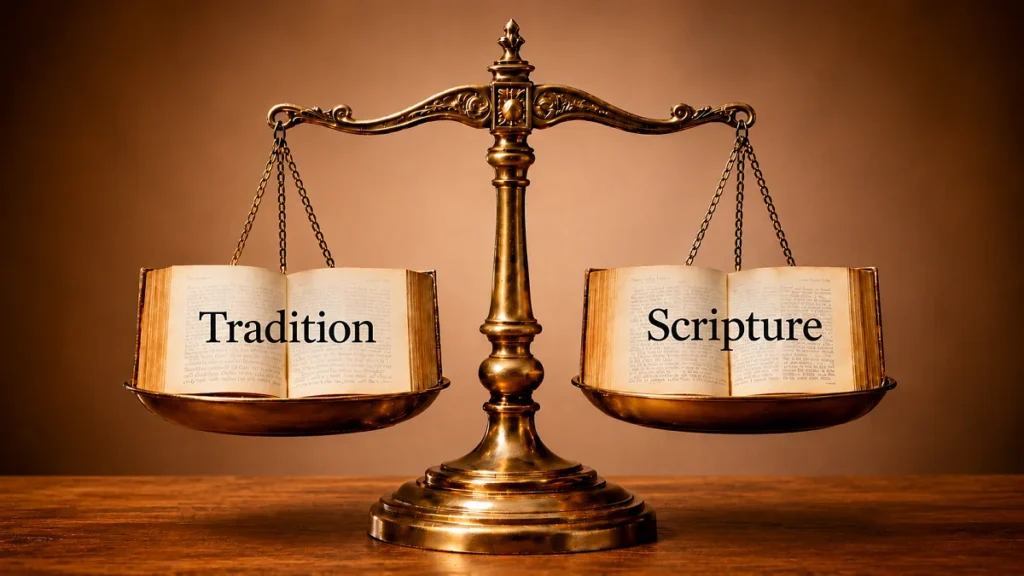
God’s Word does not teach us to trust human traditions. Some claim that they carry the same authority as Scripture. Others even claim that they outweigh Scripture. Those who make such claims set aside God’s Word for the sake of their traditions, just as the religious leaders did in Jesus’ day. Let us not follow their example.
The Apostles and Scripture
The letters of the apostles do not teach us to rely on human traditions or creeds either. These letters were written in Greek during the first century AD. Time and again, the apostles point to God’s Word in the Scriptures. Hundreds of times, they quote or refer to the written Word as recorded in the Scriptures.
When Jesus was tempted in the wilderness by the adversary, He defended Himself by using God’s Word. He answered every temptation by quoting the Scriptures. (Matthew 4:1–11)
The apostle Paul wrote to the Christians: “Do not go beyond what is written.” (1 Corinthians 4:6) Jesus also said: “The Scripture cannot be broken.” (John 10:35)
Paul knew that some would distort the truth. He warned that people would introduce religious rules and traditions that would hide the truth from Christians. Therefore, he wrote:
“Watch that there not be one robbing you through philosophy and empty deceit, according to the tradition of men, according to the elements of the world, and not according to Christ.” (Colossians 2:8, Interlinear Bible)
“For a time will be when they will not endure sound doctrine, but according to their own lusts, they will heap up to themselves teachers tickling the ear; and they will turn away the ear from the truth and will be turned aside to myths.” (2 Timothy 4:3–4, Interlinear Bible)
Paul knew that human traditions would become “philosophy,” “empty deceit,” and “myths.” These traditions would stand in opposition to the truth of God’s Word. They would proclaim a different way of salvation from the one described in the Scriptures. They would also proclaim a different god from the One revealed in Scripture. Yes, they would proclaim empty deception. Many religious people have been led away from the truth because of the traditions on which religion is built.
Go Directly to the Scriptures
If a religion requires its members to accept its creeds and teachings without support from the Scriptures, it is not speaking the truth. As sincere Christians, we must always compare a religion’s teachings with the Scriptures. If they do not agree with God’s Word, we should reject them and hold fast to the truth.
The apostle Peter had the same attitude. He gave first place to the Scriptures and never claimed to be infallible. Nor did he assume exalted titles or seek honor from others. Instead, he consistently pointed his readers to God’s unchanging Word, showing that it is able to guide them to the Kingdom of God.
Peter wrote that the words of the prophets stand firm like a lamp shining in a dark place until the day dawns. He also emphasized that no prophecy originated in human will, but from God through the Holy Spirit. At the same time, he warned about false teachers who would introduce destructive heresies. (2 Peter 1:19–21; 2:1; 3:2)
We must not seek the truth in religions, human traditions, or creeds. Instead, we should turn directly to the Scriptures, which were inspired by God through His Spirit. They are trustworthy and useful for teaching, guidance, and training in righteousness. (2 Timothy 3:16)
Truth does not change over time. If truth exists, it must be found in what is written.
Therefore, it is important to examine the Scriptures for yourself and test everything. Only in this way can we be sure that our faith is in harmony with the truth.
Related Articles
Explore More
© 2026 Skriften.dk