Who Is Yahweh?
Yahweh is the name of the God of the Bible, the God of Abraham, Isaac, and Jacob. The Bible presents Yahweh as the only true God and the Creator of heaven and earth.
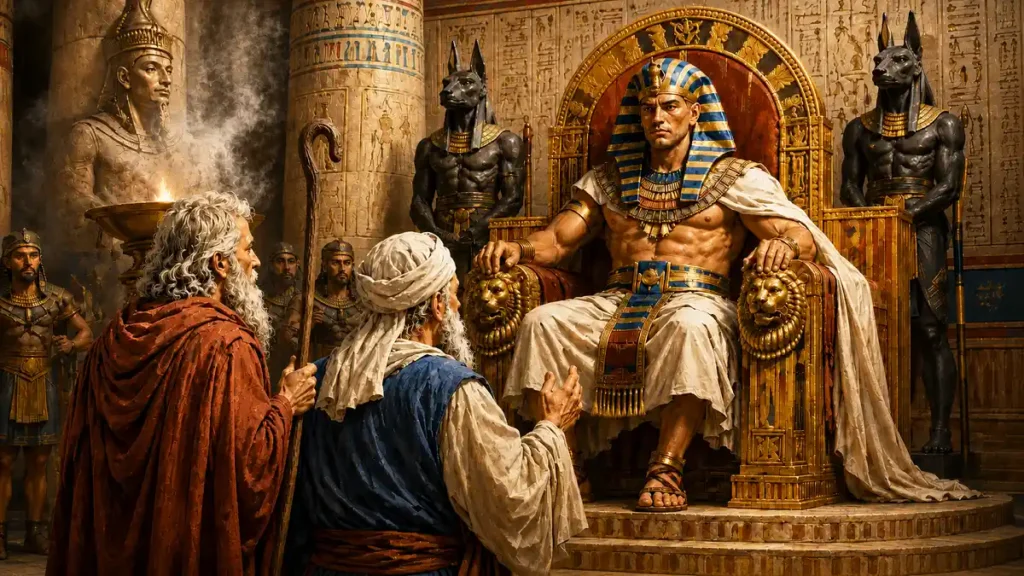
The mighty Pharaoh of Egypt asked the question: “Who is Yahweh?” He asked it defiantly and contemptuously in the sixteenth century BC. It happened when Moses and Aaron came to him with Yahweh’s message to let the Israelites go.
Pharaoh said:
“Who is Yahweh that I should listen to His voice to send away Israel? I do not know Yahweh, and I also will not send Israel away.” (Exodus 5:2, Interlinear Bible)
This question marked the beginning of a series of events through which Yahweh revealed His power. God said to Moses:
“But Pharaoh will not listen to you, and I will lay My hand upon Egypt and bring out My armies, My people, the sons of Israel, from the land of Egypt with great judgments. And the Egyptians shall know that I am Yahweh, when I stretch out My hand over Egypt and bring out the sons of Israel from among them.” (Exodus 7:4–5, Interlinear Bible)
When the Egyptians were struck by Yahweh’s judgments, Pharaoh’s magicians recognized the truth and said to him: “It is the finger of God!” But Pharaoh hardened his heart and would not listen to them, just as Yahweh had said.
The present world has also hardened its heart, just as Pharaoh did. But it too will come to understand, just as the ancient Egyptians did. The only true and living God is the One whose name is Yahweh. This realization, however, will come in a way that will not be pleasant for the world. Therefore, it is best to learn now who Yahweh is and what He is like.
God's Name Is Revealed to Moses
When Moses appeared before Pharaoh with God’s demand, he mentioned the name of the God who had sent him. He did not simply say, “Our Lord says this or that.”
Pharaoh and the Egyptians worshiped their own false gods and acknowledged them as lords. Therefore, it was important that Moses clearly stated God’s name. When Moses spoke to his own people and explained why he had returned to Egypt, he also used God’s name. In this way, he made it clear who had sent him. We read:
“And God said to Moses, I AM WHO I AM; and He said, you shall say this to the sons of Israel, I AM has sent me to you. And God said to Moses again, You shall say this to the sons of Israel, Yahweh the God of your fathers, the God of Abraham, the God of Isaac, and the God of Jacob, has sent me to you. This is My name forever, and this is My memorial from generation to generation.” (Exodus 3:14–15, Interlinear Bible)
You can see God’s name for yourself in the Hebrew text in an Interlinear Bible.
After Moses and his brother Aaron had spoken to Pharaoh for the first time, God’s Word says:
“And God spoke to Moses and said to him, I am Yahweh. And I appeared to Abraham, to Isaac and to Jacob as God Almighty, and by My name Yahweh I never made Myself known to them.” (Exodus 6:2–3, Interlinear Bible)
God's Name YHWH
The Scriptures written before the beginning of the Common Era were for the most part written in Hebrew, while a smaller portion was written in Aramaic. Throughout these Scriptures, from the first book to the last, we find God’s name written as YHWH.
This name consists of four Hebrew consonants and is known as the Tetragrammaton. It occurs a total of 6,823 times in the Scriptures. The Scriptures were first translated into Greek during the period 285–247 BC, and this translation is known as the Septuagint (LXX). But even before this time, the Jews had stopped pronouncing God’s name because they superstitiously feared using it incorrectly.
Therefore, when they read the Scriptures and came to God’s name, they pronounced the word Adonai, meaning “Lord,” instead. When the translators later worked on the Greek translation, they followed this tradition. They therefore did not translate God’s name itself, but used the corresponding Greek word Kyrios, which also means “Lord.”
This is why Jesus says, “The Lord (Kyrios) is one” (Mark 12:29), rather than “Yahweh (YHWH) is one,” as it reads in Deuteronomy 6:4.
Bible Translations and the Use of God's Name
The apostles and evangelists who wrote the apostolic writings used the Septuagint and quoted from its Greek text. This text omitted the personal name of God Almighty, Yahweh, and used the word Lord (Kyrios) instead. This explains why God’s name does not appear in the apostolic writings.
Jerome, one of the Western Church Fathers, followed the same practice when he produced the Latin translation known as the Vulgate. This was done between AD 382 and 405. He used the title Adonai instead of the name Yahweh, which explains why the name does not appear in the Catholic Douay translation.
In the English King James Version, the name is rendered “Jehovah” in several passages. These include Exodus 6:3, Psalm 83:18, Isaiah 12:2, and Isaiah 26:4. Rotherham’s translation, The Emphasized Bible, renders the name “Yahweh” in all 6,823 places where it occurs. The Catholic Jerusalem Bible likewise uses “Yahweh.”
None of these pronunciations corresponds exactly to the way God’s name was originally pronounced. Nevertheless, they help us clearly understand who is meant when the name is used. Nor do we pronounce the name Jesus exactly as it would have sounded in Hebrew. Jesus’ Hebrew name is Yeshua. The approximate pronunciation still enables us to understand clearly who is meant.
Confusion About God's Name in Bible Translations
As an example of the confusion that can arise when God’s name is rendered as “Lord,” consider Psalm 110:1–2. In many Bible translations, the distinction between God’s personal name and the title “Lord” is not immediately apparent.
Since Jesus is also called “Lord” in the apostolic writings, for example in Ephesians 1:2, this can easily lead to misunderstanding. A reader might even get the impression that the same Lord is speaking to Himself in Psalm 110:1.
But the Catholic Jerusalem Bible renders the opening words of this psalm of King David:
“Yahweh’s oracle to you, my Lord, Sit at my right hand and I will make your enemies a footstool for you.”
By using God’s name, Yahweh, the distinction becomes clear. “My Lord” refers to Christ, while Yahweh is the One speaking to Him.
Some English Bible translations preserve this distinction in another way. The King James Version, for example, generally renders the divine name YHWH as “LORD” in capital letters, while the Hebrew title Adonai is rendered “Lord.” Psalm 110:1 therefore reads:
“The LORD said unto my Lord, Sit thou at my right hand, until I make thine enemies thy footstool.”
The use of LORD and Lord helps the reader see that two different Hebrew expressions stand behind the English translation. LORD represents the divine name YHWH, while Lord represents a title.
However, when a translation simply uses “Lord” without clearly indicating whether the underlying Hebrew text contains YHWH or Adonai, this important distinction becomes less apparent. The reader may then fail to see that the Hebrew text distinguishes between Yahweh and Lord.

Yahweh Is the Most High
By looking up the verses in which God’s name appears in the Bible, we find the answer to the question: Who is Yahweh?
In Psalm 83:18 we read:
“And let them know Your name is Yahweh, that You alone are the Most High over all the earth.” (Interlinear Bible)
“For You, Yahweh, are exalted above all the earth; You are lifted on high far above all gods.” (Psalm 97:9, Interlinear Bible)
“For I know that Yahweh is great, and our Lord is above all gods.” (Psalm 135:5, Interlinear Bible)
Since Yahweh is the Most High, exalted above all gods, He is also the God of gods:
“For Yahweh your God, He is the God of gods, and the Lord of lords; the great, the mighty, the fearful God who does not lift up faces, nor take a bribe.” (Deuteronomy 10:17, Interlinear Bible)
Yahweh Is Eternal and One
In Psalm 90 we read:
“Lord, You have been our dwelling-place in all generations. Before the mountains were born, or ever You had formed the earth and the world, even from everlasting to everlasting You are God… Return, O Yahweh! How long? Have compassion on Your servants!” (Psalm 90:1–2, 13, Interlinear Bible)
Yahweh is from everlasting to everlasting—that is, He has no beginning. In the book of Isaiah we read that God lives forever:
“For so says the high and lofty One who inhabits eternity, and His name is Holy: I dwell in the high and holy place…” (Isaiah 57:15, Interlinear Bible)
Concerning Yahweh’s nature, the Scriptures declare that Yahweh is one:
“Hear, O Israel: Yahweh our God, Yahweh is one.” (Deuteronomy 6:4, Interlinear Bible)
Yahweh, the Creator of All Things
The Scriptures declare that Yahweh is the Creator of heaven and earth:
“For Yahweh is great and greatly to be praised; He is to be feared above all gods. For all the gods of the peoples are idols; but Yahweh made the heavens.” (Psalm 96:4–5, Interlinear Bible)
“You alone are He, O Yahweh; You have made the heavens, and heavens of the heavens, and all their host; the earth and all which is on it; the seas, and all that is in them; and You shall preserve them all alive. And the host of the heavens bows down to You.” (Nehemiah 9:6, Interlinear Bible)
“For, behold, He who forms mountains and creates the wind and declares to man what His thought is, He who makes the dawn darkness, and treads on the high places of the earth, Yahweh, the God of Hosts, is His name.” (Amos 4:13, Interlinear Bible)
“Praise Yahweh! Praise Yahweh from the heavens; praise Him in the heights. Praise Him, all His angels; praise Him, all His hosts. Praise Him, sun and moon; praise Him, all you stars of light. Praise Him, O heavens of heavens; and O waters that are above the heavens. Let them praise the name of Yahweh; for He commanded, and they were created.” (Psalm 148:1–5, Interlinear Bible)
The Scriptures also tell us that Yahweh is a compassionate and gracious God, yet He does not leave the guilty unpunished:
“And Yahweh passed by before his face and called out: Yahweh! Yahweh God! Merciful and gracious, slow to anger, and great in goodness and truth, keeping mercy for thousands, forgiving iniquity and transgression and sin, and not leaving entirely unpunished, visiting the iniquity of fathers on sons, and on sons of sons, to the third and to the fourth generation.” (Exodus 34:6–7, Interlinear Bible)
Yahweh Is the Only God
Since the Scriptures say both that Yahweh is the only God and the God of gods, this may at first seem contradictory. The Bible teaches that there are other gods (elohim) in heaven, but none is like Yahweh. He alone is without beginning. He alone is worthy of all worship. He is the One who created all the other heavenly beings called elohim. There is no one like Him, and therefore He alone is God.
“Before Me there was no God formed; nor shall any be after Me. I, I am Yahweh; and there is no Savior besides Me. I declared, and I saved, and I proclaimed; and there is not an alien god among you. And you are My witnesses, says Yahweh, and I am God.” (Isaiah 43:10–12, Interlinear Bible)
“I am Yahweh, and there is none else; there is no God except Me. I will clothe you, though you do not know Me, that they may know from the rising of the sun, and to the sunset, that there is none besides Me; I am Yahweh, and there is none else.” (Isaiah 45:5–6, Interlinear Bible)
“Know today, and lay it to your heart, that Yahweh, He is God in the heavens above and on the earth beneath; there is no other.” (Deuteronomy 4:39, Interlinear Bible)
Yahweh, the Eternal King
Yahweh reigns forever over all His creation. He alone is worthy of all honor and praise. The apostle Paul wrote:
“Now to the King eternal, incorruptible, invisible, the only wise God, be honor and glory forever and ever. Amen.” (1 Timothy 1:17, Interlinear Bible)
Yahweh is eternal and immortal, and some believe that His name means “He who exists by Himself.” It has also been understood to mean “the Eternal One.” (Strong’s Exhaustive Concordance 3068)
There must have been a time when Yahweh was completely alone. All life, all power, and all thought existed in Him alone. Yet He could not have been lonely, for He is perfect in Himself. He is complete and lacks nothing.
The First Created Beings
Then came the time when Yahweh began to create. Only then did He become God in relation to His creation. For this reason, He is called God in the very first verse of the Bible, where creation is described:
“In the beginning God created the heavens and the earth.” (Genesis 1:1, Interlinear Bible)
Since Yahweh is both God and the Creator, the expression “Yahweh God” is an appropriate designation for Him. This expression appears immediately after the creation account. We read:
“These are the generations of the heavens and of the earth when they were created, in the day that Yahweh God was making earth and heavens.” (Genesis 2:4, Interlinear Bible)
Yahweh’s first creations were spirit beings like Himself. They are called the “sons of God” and were present when He later created the earth (Job 38:4, 6–7). They are also the ones whom the Scriptures call gods (elohim), and this is why Yahweh is called the God of gods.
In John 4:24 we read:
“God is spirit.”
Since Yahweh is spirit, He is invisible to human eyes. He Himself said to Moses:
“You are not able to see My face, for no man can see Me and live.” (Exodus 33:20, Interlinear Bible)
A human being of flesh and blood would therefore die if he were to see God’s face.
Yahweh Reveals Himself Through Creation
Although Yahweh is spirit and invisible to human eyes, He has made Himself known through His magnificent creation. For this reason, the Scriptures condemn those who deny His deity or refuse to acknowledge Him as God and Creator.
“For the unseen things of Him from the creation of the world are clearly seen, being understood by the things made, both His eternal power and divinity, for them to be without excuse.” (Romans 1:20, Interlinear Bible)
As the Creator, Yahweh is the source of all life, all power, and every good quality. His works are perfect in everything He does. Moses sang this song in His praise:
“I will proclaim the name of Yahweh and ascribe greatness to our God. He is the Rock. His work is perfect, for all His ways are justice. A God of faithfulness and without injustice, righteous and upright is He.” (Deuteronomy 32:3–4, Interlinear Bible)
Therefore, the Scriptures also say of Him:
“Every act of good giving and every perfect gift is from above, coming down from the Father of lights, with whom is no change or shadow of turning.” (James 1:17, Interlinear Bible)
The Rebellion and the Fall of Man
Yahweh organized His holy, intelligent creatures in heaven into a harmonious and peaceful family, with Himself as their Head. In this way, His will would be carried out. All the heavenly sons of God formed His family in heaven. They were all God’s sons and had received life from Him. When the perfect man and woman were created and placed in the Garden of Eden, they became part of His earthly family. They were to carry out the work that God had entrusted to them.
Adam was not born of a woman but was a direct creation of God. Therefore, the Scriptures call him “the son of God” (Luke 3:38). Adam and Eve forfeited their right to life when they transgressed Yahweh’s law and joined the rebellion against Him.
Yahweh is the Supreme Ruler and Lawgiver of the universe. As the Creator and Head of His family, He rightfully exercises authority in heaven and on earth. The great question in heaven and on earth is this: Who has the right and the ability to rule the universe? In other words, who has the right to be the Most High? Yahweh’s purpose is to settle this question clearly and decisively. In doing so, His universal sovereignty will be fully vindicated.
Yahweh's Victory and Eternal Kingdom
A prayer that Yahweh will establish His position as the Most High is found in Psalm 83:17–18:
“Let them be ashamed and terrified forever; let them be confounded and perish. And let them know Your name is Yahweh, that You alone are the Most High over all the earth.” (Interlinear Bible)
His supremacy will be established beyond all doubt, so that it can never again be denied. When Yahweh has established His rule by destroying all His enemies in heaven and on earth, all will acknowledge Him. Everyone will know that Yahweh alone is the Most High over all the earth. His Kingdom will rule over every inhabited part of the universe. His laws will be obeyed everywhere. A rebellion like the one that began when Satan said to Eve, “You shall surely not die,” will never occur again.
Once and for all, Yahweh will have established that He alone is the Most High and the rightful Ruler of the entire universe. As the twenty-four elders say in heaven:
“Lord, You are worthy to receive the glory and the honor and the power, because You created all things, and through Your will they exist and were created.” (Revelation 4:11, Interlinear Bible)
Pharaoh’s question, “Who is Yahweh?“, is therefore not merely a historical question—it is one that every person must answer.
Related Articles
Explore More
© 2026 Skriften.dk