Who Are the Demons?
Demons in the Bible are described as evil spirits and supernatural beings that are active among humans. The Hebrew word shedim and the Greek word daimon are translated as “demons,” “spirits,” or “supernatural beings.” They are also referred to as elohim and as evil spirits. They influence, deceive, and destroy—but who are they, and where do they come from?
Scripture does not provide a single, complete explanation of their origin in one place. But when we bring together the different accounts found throughout the Scriptures, a clearer picture emerges.
Demons Are Evil Spirits
Demons are invisible spiritual beings that are evil by nature. They operate unseen, but the results of their activity can be seen in deception, delusion, war, and destruction.
Scripture shows that the angels who sinned in Noah’s day are no longer free to act:
“For if God did not spare sinning angels, but delivered them to chains of darkness, thrust down into Tartarus, having been kept to judgment.” (2 Pet. 2:4, Interlinear Bible)
They are therefore bound in the abyss. Yet we encounter demons in the Gospels. They are active, they influence people, and they fear being sent into the abyss.
When Jesus encountered the demon-possessed man in Luke 8, it became clear that many demons were in him. They knew who Jesus was, recognized his authority, and begged him not to send them into the abyss:
“And they begged Him that He not order them to go away into the abyss.” (Luke 8:31, Interlinear Bible)
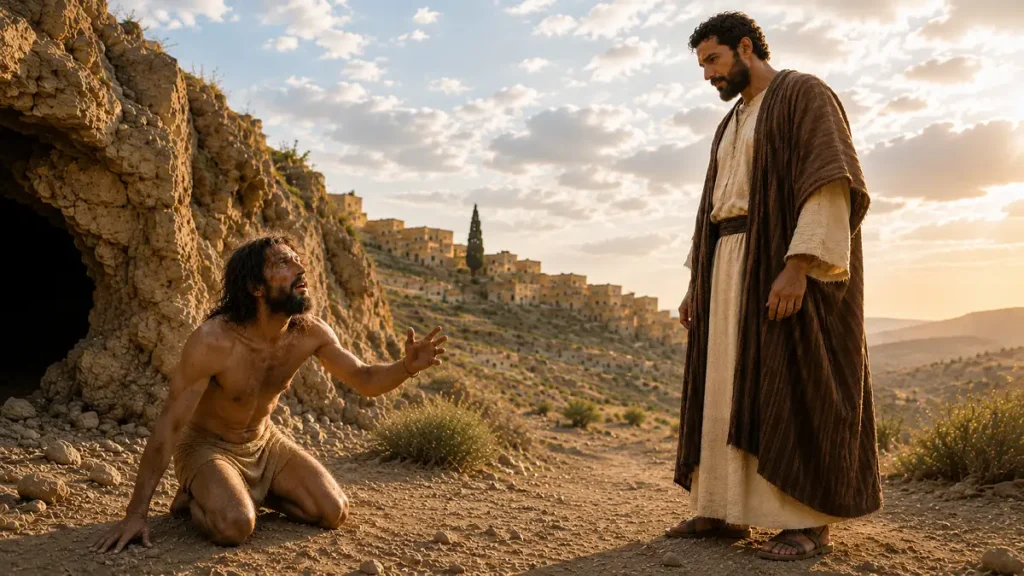
The demons must therefore be something other than the fallen angels from Noah’s day. This also shows that demons are real spiritual beings with will and consciousness. They seek to inhabit bodies of flesh and blood, which is unusual—unless they had once inhabited such bodies themselves.
The Origin of Demons
Scripture shows that the demons are not the fallen angels themselves.
The sons of God who sinned in Noah’s day are being kept in chains of darkness until judgment (2 Pet. 2:4). But the demons are still active and move freely on the earth.
An explanation can be found in their connection with the Nephilim, the giants.
The Nephilim were the result of the union between the sons of God and the daughters of men (Gen. 6). When they were killed in the Flood, their spirits left their bodies. These spirits became evil spirits. They are the demons we read about in Scripture. In First Enoch we read:
“And now, the giants, who are produced from the spirits and flesh, shall be called evil spirits upon the earth, and on the earth shall be their dwelling. Evil spirits have proceeded from their bodies; because they are born from men and from the holy Watchers is their beginning and primal origin.” (First Enoch 15:8–9)

The demons in the Bible are therefore not heavenly beings who fell, but spirits that originated from a forbidden union between spirit and flesh. The evil spirits came forth from the Nephilim when their fleshly bodies died in the Flood. This also explains why they seek to possess human beings and make them their dwelling place: they had previously possessed bodies of flesh (Matt. 12:43–45).
The Activity of Demons
Scripture shows that demons are active among humans with the purpose of corrupting and misleading them.
They are behind:
- war and destruction
- deception
- spiritual delusion
- false religious teachings
The apostle Paul writes:
“But the Spirit expressly says that in latter times some will depart from the faith, cleaving to deceiving spirits and teachings of demons.” (1 Tim. 4:1, Interlinear Bible)
The activity of demons is therefore seen not only in obvious evil, but also in religion and religious teaching.
Demons Under Satan
The demons are under Satan, who is the ruler of this world:
“And the chief of the spirits, Mastêmâ (Satan), came and said: ‘Lord, Creator, let some of them remain before me, and let them harken to my voice, and do all that I shall say unto them; for if some of them are not left to me, I shall not be able to execute the power of my will on the sons of men; for these are for corruption and leading astray before my judgment, for great is the wickedness of the sons of men. And He said: Let the tenth part of them remain before him, and let nine parts descend into the place of condemnation.” (Book of Jubilees 10:8–9)

God granted Satan’s request, and therefore many demons remain under his authority, enabling him to exercise his power over mankind. This authority has been handed over to him. It extends to both secular and religious power. Satan is, after all, the ruler of this world (Luke 4:5–6) and the god of this world (2 Cor. 4:4).
The Spiritual Battle
Scripture teaches that the struggle of believers is not against flesh and blood—that is, against human beings—but against spiritual forces of wickedness:
“We are not wrestling against flesh and blood, but… against the spiritual powers of evil in the heavenlies.” (Eph. 6:12, Interlinear Bible)
This battle is waged not only through obvious evil, but also through deception.
The religions and religious teachings of the world are influenced by what Scripture calls teachings of demons. When people turn away from the true God and worship other gods, these are not merely neutral or harmless beliefs. Scripture shows that spiritual powers stand behind them:
“But the things the nations sacrifice, they sacrifice to demons, and not to God.” (1 Cor. 10:20, Interlinear Bible)
The gods people worship are therefore not merely human ideas, but demonic powers that seek worship and lead people away from the truth.
For this reason, we must hold firmly to the truth of Scripture and not allow ourselves to be led astray by the teachings of demons.
Brief Summary
- Demons are evil spirits.
- They are not the fallen angels from Noah’s day.
- They are connected with the Nephilim.
- They work to deceive and destroy.
- They are under Satan and his rule.
Demons in the Bible are described as real spiritual powers that are active among humans and seek to lead them away from the truth. When the Bible’s various accounts are brought together, a more nuanced picture emerges than the one commonly presented by religious traditions.
Related Articles
Explore More
© 2026 Skriften.dk